LAB REPORT: NanoFabrication CORE Facility
Supporting and Promoting SoE Research and Collaborations
Ngwe Zin is the director and principal investigator of the School of Engineering (SoE) Nanofabrication CORE Facility (NCF), as well as a graduate faculty member in the SoE Department of Electrical and Computer Engineering.
Nanofabrication is the process of designing and building structures and products – especially electronics devices – that are measured in nanometers. Since its establishment in 2019, the NCF has been a clean room facility for the creation of micro, or nanoscale, devices.
Its controlled environment and specialized equipment are used for lithography, material deposition, etching, and more for research projects in electronics, photonics, and Micro-Electro Mechanical systems, or MEMS.
A Supportive Mission
The NCF is dedicated to supporting SoE research activities; promoting research collaboration between research centers and industry; engaging in student and postdoc workforce development activities that provide skills that can be applied in high-tech industries and research institutes; and procuring research income through grants, user access fees, and training programs.
“In addition to our research activities and initiatives, I am especially proud of the support NFC receives from the office of the SoE Dean and from colleagues across the SoE and SAS, as well as from our dedicated and highly skilled team,” Zin says.
An Up-to-Date Facility for University Researchers, Students, and Others

As NCF PI, Zin leads a team of two staff members, as well as postdoctoral and graduate students in a variety of research projects. Users, besides SoE researchers, according to Zin, include Rutgers School of Arts and Science researchers and collaborators, industry partners, external research labs, and startups.
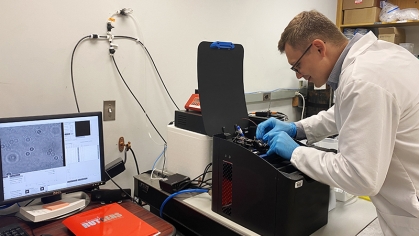
They work in a state-of-the-art facility equipped with up-to-date fabrication tools, such as atomic layer deposition and various furnaces; characterization tools such as a scanning electron microscope and UV and solar simulator; as well as wet chemical processes such as buffered oxide etch and silicon surface texturing.
Primary Research Support
“NCF supports primary research focused on microelectronic and semiconductor devices; materials science; 2D and 3D materials; photovoltaics, lab-on chips; biomedical devices, and Micro-Electro-Mechanical Systems (MEMS),” says Zin.
He reports that NCF has received a number of recent grants including Rutgers I-Corps Propelus Program; a matching grant from the SoE; a CORE facility infrastructure grant; NSF I-Corps Northeast Regional Program; and DOE SETO SIPs funding.
Research Collaborations
Fostering productive collaborations between research laboratories and industry is central to the NFC mission.
Zin highlights active collaborations with Brookhaven National Laboratory for the investigation of novel dissolved ozone oxide performances at both structural and atomic levels. NFC is also collaborating with EDM Electronics to develop a photoresist for E-beam lithography, as well as collaborating in a semiconductor workforce development program with the SoE Department of Electrical and Computer Engineering.
Generating Income through Trainings
In addition to bringing in income through grants, according to Zin, NFC generates income by conducting trainings for new and existing users, and usage fees paid by users for access to a range of process tools and characterization and testing instruments.