
Since 2024, the multi-million-dollar state and federally funded Rutgers Agrivoltaics Program (RAP) has been seeking to generate and harvest electricity by installing wind farms on actively farmed land.


Stepping Up to Discovery and Innovation
Rutgers School of Engineering is a national leader in discovery and innovation. Our Rutgers Edge pushes us to be at the forefront of educating the next generation of innovators, improving lives and advancing technology through focused, transdisciplinary research, and creating equitable solutions while contributing to New Jersey's economic growth.
Engineering for the Future
Organized across ten engineering fields, Rutgers Engineering is uniquely positioned to address complex global challenges.
Infrastructure underpins the foundational systems that support societies and economies. From transportation and communication to energy and water systems, Rutgers Engineering is leveraging research strengths in resilience, sustainability, automation, cyberinfrastructure, wireless communication, and aeronautics.
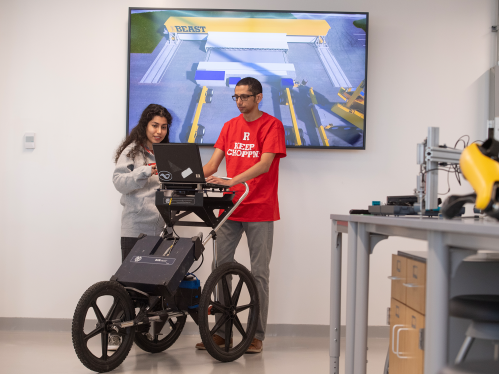
Rutgers Engineering's solutions are revolutionizing battery technology, generating electricity on farm land, transforming seaweed into fuel, exploring emerging fusion technologies, and more. Working together, Rutgers Engineering and New Jersey are national leaders in the field of clean energy, with the state setting one of the nation's boldest clean energy goals by 2035.
Since 2024, the multi-million-dollar state and federally funded Rutgers Agrivoltaics Program (RAP) has been seeking to generate and harvest electricity by installing wind farms on actively farmed land.

“Batteries power our lives and transform society,” says Glenn Amatucci, a professor in the Department of Materials Science and Engineering and director of the Energy Storage Research Group.

Rutgers’ interdisciplinary Master of Engineering degree in Energy Systems integrates technology and science with business, IT, public policy, and regulatory study.
The field of healthcare is undergoing a significant transformation, driven by technological advancements and evolving patient needs. Rutgers Engineering is delivering research success in areas such as pharmaceutical manufacturing, regenerative medicine, diagnostic devices, and gene and vaccine delivery.

At Rutgers, defense research is rigorously applied in aerospace, mechanical, electrical, materials, and systems engineering, as we pursue new developments in hypersonic testing and simulation activities, drone design and automation, game theory and cybersecurity, smart manufacturing, and novel materials.
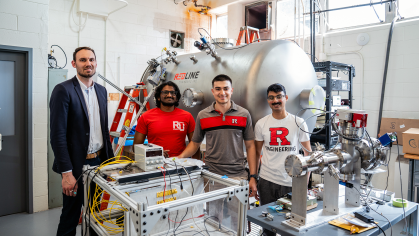
With a Defense Advanced Research Projects Agency (DARPA) grant, Assistant Professor Steven Berg is seeking a way to enable sustained flight at VLEO (very low Earth orbit), the “no man’s land” between spaceflight and atmospheric flight.
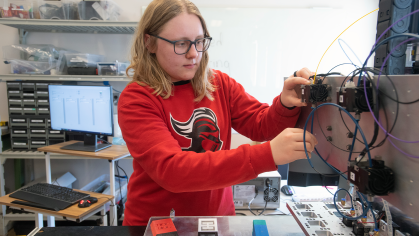
According to Department of Mechanical and Aerospace Engineering Associate Professor Rajiv Malhotra, additive manufacturing (AM) printers offer significant potential for in-field 3D printer fabrication by defense personnel.
Read More
Read the Stepping Up brochure to discover more about how Rutgers Engineering improves lives and advances technology through focused research and education.