MSE Professor Awarded DOE Grants to Continue Work on Immobilizing Nuclear Waste
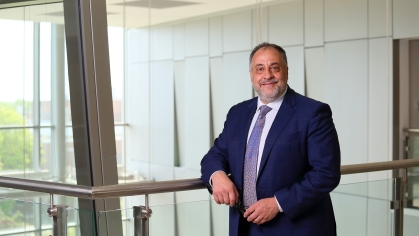
Ashutosh Goel, a professor in the Department of Materials Science and Engineering, and a widely recognized leader in glass and ceramic technology, has long focused his research on the safe immobilization and long-term disposal of nuclear waste.
Recent awards from two divisions of the U.S. Department of Energy (DOE) will support Goel's ongoing development and deployment of sophisticated materials science solutions to address this critical challenge.
According to Goel, the global energy surge caused by electrification and the rapid expansion of AI data centers has prompted a nuclear renaissance, with the U.S. restarting existing reactors and deploying next-generation nuclear systems—and generating gallons of back-end reactor nuclear waste.

Goel is the Principal Investigator, or PI, on a one-year, $900,000 award from the DOE's Hanford Field Office for research addressing scientific barriers in developing advanced glass formulations with higher waste loadings and improved chemical durability.
This collaborative work with researchers at Washington State University supports clean-up efforts at the Hanford, Washington site—where approximately 56 millions gallons of legacy nuclear waste are stored in underground tanks, and must be permanently immobilized in glass.
"The state-of-the-art technology for immobilizing the waste is glass," Goel notes. "And that's what the Hanford mission is all about."
A New Technology to Meet the Challenge of Next-Generation Nuclear Waste Disposal
The DOE's Advanced Research Projects Agency-Energy (ARPA-E) has awarded a one-year, $800,000 grant to a multi-institutional team led by PI Goel. He is joined by researchers from the University of South Carolina, the Savannah River National Lab, and Pacific Northwest Laboratory, as well as nuclear energy industry leaders Curio Legacy Ventures, headquartered in Washington DC, and Bill Gates' Bellevue, Washington TerraPower company.
Goel says the ARPA-E grant, which was approved in December, enables the continuation of his team's work under the agency's Optimizing Nuclear Waste and Advanced Reactor Disposal Systems (ONWARDS) program. "It's all about enabling the next generation of nuclear reactors that are being deployed to ensure a reliable source of baseload power," he explains.
As he describes it, the project's goal is to advance the commercialization of ceramic-metal composite Cermet—a new technology designed with the potential to solve the nuclear waste problem stemming from newly deployed reactors.
"It would be especially challenging to immobilize the type of waste next-generation reactors produce," explains Goel. "Cermet can actually take care of the waste coming out of next-generation reactors. It's more cost-efficient than glass, and our industry partners like this and are willing to try it. I'm fairly sure this will work and open a lot more doors to commercializing this technology worldwide."
Considered in tandem, the two projects, Goel states, "highlight how materials science underpins the future of nuclear energy—ensuring that, as the world looks to nuclear power for a cleaner energy transition, the resulting waste is managed safely and responsibly for generations to come."