MAE Professor Jingang Yi Named IEEE Fellow
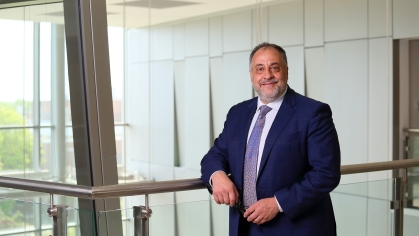
School of Engineering Mechanical and Aerospace Engineering Professor Jingang Yi has been named a Fellow by the Institute of Electrical and Electronics Engineers (IEEE), the world's leading professional organization dedicated to advancing technology for the benefit of humanity.
IEEE has recognized Yi's outstanding contributions to motion control for robotics and semiconductor manufacturing by honoring him with the prestigious grade of Fellow — its highest level of IEEE membership.

"My research area is mainly centered around robot dynamics and control," notes Yi. "Being named an IEEE Fellow is a deeply meaningful honor for me. Personally, it represents recognition of years of dedication, perseverance, and passion for advancing my field.
"Professionally," he adds, "it affirms the impact of my work within the global engineering and research community and motivates me to continue contributing through innovation, mentorship, and service to the profession."
Foundational Contributions to the Field
The IEEE has signaled Yi out for his foundational contributions to the modeling and control of robotic systems in the presence of friction. "I developed innovative methods and system-level frameworks for friction modeling, sensing, and control across a broad range of applications, including autonomous vehicles, mobile robots, semiconductor cluster tools, and bipedal walkers," he says.
He leveraged his novel wheel-ground friction models for autonomous vehicles and wheeled robots to "design adaptive braking control systems that both maximize braking performance and estimate friction forces in real time, thereby enhancing safety."
This work, he recalls, "was among the first to demonstrate that intentionally unstable, yet safe strategies employed by expert drivers, can be systematically incorporated into the design of high-performance, safety-critical motion controllers."
The IEEE also acknowledged Yi's pioneering work on robot control, planning, and scheduling algorithms for semiconductor manufacturing cluster tools.
"I was the first to formulate and solve complex robot motion scheduling and planning problems for multi-cluster tools that are central to wafer fabrication," he says.
According to Yi, performance analysis and operation have been substantially streamlined by his creation of a new analytical framework that provides a unified treatment of robots, process modules, and buffer modules in multi-cluster tools with general configurations.
"My research," he reports, "has had direct industrial impact, with practical implementations in semiconductor labs, that has led to measurable improvements in operational efficiency and productivity."
A New Focus on Human-Robot Interactions
Yi's current research includes projects involving legged robotics and physical human-robot interactions, with a focus on enabling reliable bipedal locomotion in challenging real-world applications, such as moving ships, trains, and aircraft. "This research aims to extend the practical deployment of legged robots to real operational environments where conventional approaches are no longer reliable," he explains.
Since Yi's nomination as an IEEE Fellow was through the organization's Robotics and Automation Society (RAS), he plans to attend his induction during the RAS Awards Ceremony at the 2026 IEEE International Conference on Robotics and Automation (ICRA) scheduled for June in Vienna, Austria.