How SoE Faculty are Engineering Summer Break
Forget about taking the summer off. For many School of Engineering faculty members and students, the summer of 2026 is an exciting and ambitious time to focus on everything from preparing for the arrival of a new hypersonic wind tunnel to laying the groundwork for future SoE scientific collaborations.
Getting Ready for GANDALF
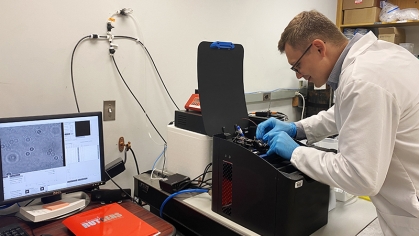
Recently inducted American Institute of Aeronautics and Astronautics (AIAA) Associate Fellow, Department of Mechanical and Aerospace Engineering Associate Professor Edward DeMauro will be spending the summer with his research team preparing for the arrival and installation of a new hypersonic wind tunnel in mid-August.
"The new hypersonic facility is termed a hypervelocity expansion tube, which we've christened the Gas and Aerothermodynamics Nozzle-free Device Advanced Laboratory Facility, or GANDALF," says DeMauro.

Developing logically from his upgrade of techniques used with Rutgers' Emil Buehler Supersonic Tunnel, the new expansion tube will be able to produce air flows greater than eight times the speed of sound, at temperatures above 450 degrees Fahrenheit.
"In contrast to the existing blowdown supersonic wind tunnel, this will allow us to explore the aerothermodynamics of objects moving through gases at speeds of about five kilometers per second," DeMauro explains.
His team includes Research Associate Tomas Rojas Carvahal, as well as five Ph.D. students, and several master's and undergraduate students.
Sharing System Reliability Modeling Insights in Asia
David Coit, a professor in the Department of Industrial and Systems Engineering and internationally recognized leader in system reliability and optimization, has been traveling in Asia delivering keynote addresses at conferences in Bangkok, Thailand, and Singapore, and visiting three Chinese universities as an invited seminar speaker.

In June, he spoke at the 23rd International Joint Conference on Computer Science and Software Engineering (JCSSE) in Bangkok, while in July he will be in Singapore to speak at the 12th Asia-Pacific International Conference on Advanced Reliability and Maintenance Modeling (APARM).
Coit was also an invited seminar speaker at China's Tsinghua University—considered China's top university in engineering; University of Chinese Academy of Sciences (UCAS); and Dalian University of Technology.
"All of my speeches and seminars pertain to predictive maintenance or reliability models for complex systems, where each individual component's failures are predicted through machine learning models, but all decisions must be planned with system-level constraints in cost, time, and resources," he explains.
"This creates a difficult mathematical optimization model, whose solution can lead to efficient planning models to maintain high levels of operational performance at reasonable costs."
Collaborating in Grand Bahama
Civil and environmental engineering associate professor Efthymios Nikolopoulos kicked off his summer by spending a week with ten students from a number of colleges and universities—including two from Rutgers—who are embarking on a six-week NSF International Research Experiences for Students (IRES) field campaign on Grand Bahama.
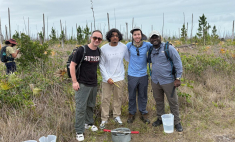
Nikolopoulos describes the current NSF-funded project as one with a central scientific perspective: "to study combined roles of social and hydrological dynamics on the post-hurricane recovery of freshwater resources on small sub-tropical islands."
To that end, the interdisciplinary field program's research focus is on the core disciplines of anthropology: environmental science and ecology; hydrology and hydro-climatology; and socio-hydrology.
"Hydrology," Nikolopoulos explains, "is our core students' discipline, but the idea is to expose them to the concepts of socio-hydrology and allow them to learn from disciplines such as anthropology and ecology."
Nikolopoulos predicts that this will be "an intense but rewarding six-week adventure full of field sampling, community engagement, and cross-institutional collaboration."
Laying Groundwork for Scientific and Academic Collaborations
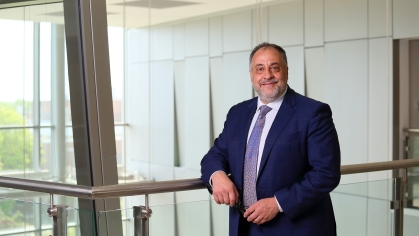
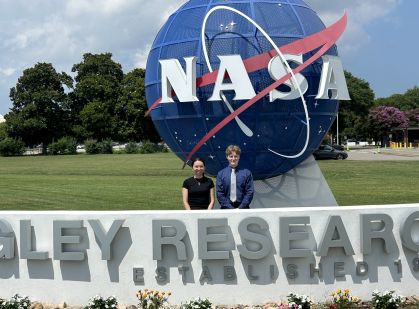
Department of Materials Science and Engineering (MSE) Professor and Chair Ashutosh Goel is keeping busy this summer by visiting NASA-Langley to deliver a talk and interact with researchers. His hope, he says, is to establish a scientific collaboration between NASA and the MSE department.
He will also be traveling to India to lay the groundwork for a joint 1+1 master's program in MSE between Rutgers and the Indian Institute of Technology in Delhi.
Closer to home, Goel is hosting several New Jersey high school students in his lab this summer, providing them with exposure to materials science and engineering research. "In addition," he reports, "I'll be delivering talks and interacting with high school students through the New Jersey Governor's School of Engineering and Technology (GSET) at Rutgers summer program to create awareness about materials science and engineering."
Additionally, several of his undergraduate and Ph.D. MSE students, he notes, will be enjoying internships at national laboratories, including Idaho National Lab; Lawrence Livermore National Lab; and Pacific Northwest National Laboratory.
Expanding Research into Fundamental Process Science
For the past couple of years, Department of Mechanical and Aerospace Engineering Associate Professor Jonathan Singer has been focused on figuring out fundamental process science.
This summer, he says, his lab is "crawling in summer research with the help of 11 undergraduates and an equal number of high school students joining them in July."

This influx of students provides Singer's lab with the opportunity and challenge to find applications for the new processes he's been developing that have potential for everything from energy and healthcare to food science and agriculture.
As one example, he hopes to fulfill some of the industrial needs and technical gaps following the regulation of PFAs—the so-called forever chemicals that find their way and linger in our bodies.
The wide range of affected consumer products, from razors, to pans, to air filters, according to Singer, illustrates the opportunity for innovation. "These companies haven't done research in a really long time, and their products don't work as well now that they no longer have facile anti-stick or easy-glide coatings. This is a place where an alternative coating technology can provide significant and immediate impact."
Immersing Pre-College Students in Engineering
Rising high school juniors and seniors can explore engineering disciplines and career options in the week-long immersive, residential Rutgers Honors Engineering Experience (RHEX).
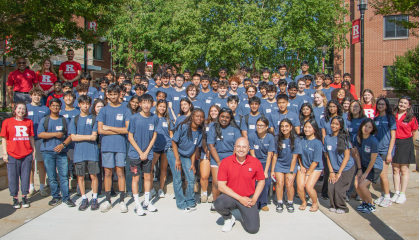
For the third summer, Annalisa Scacchioli, an associate teaching professor in the Department of Mechanical and Aerospace Engineering (MAE) is among the SoE faculty teaching in this year's program. She integrates her lectures with the student teams' hands-on experience of building machines—and presenting their projects. As a way to share insights on what it is like to be a Rutgers Engineering student, undergraduates from her Introduction to Mechatronics course present a showcase of their mechatronics prototypes to the campers.
Other popular summer engineering programs at Rutgers include TARGET, which increases awareness and introduces career opportunities in engineering to middle and high school students, while the New Jersey Governor's School in Engineering and Technology's intensive residential program admits talented pre-engineering high school students.
SLAAM is a selective program in which students engage in research and applied work with the MAE department. A summer residency program for incoming Educational Opportunity Fund (EOF) and Engineering Opportunity Program (EOP) students exposes them to SoE academics, while introducing them to a supportive community and resources to foster their success.