FICUS Grants CBE Professor's Research Project Access to DOE User Facilities
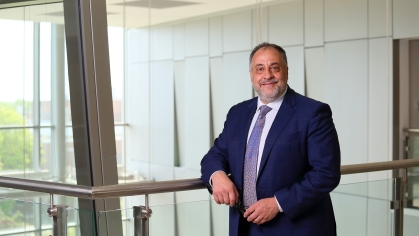
Shishir Chundawat, an associate professor in the Department of Chemical and Biochemical Engineering, is the principal investigator, or PI, on one of ten projects selected through the Facilities Integrating Collaborations for User Science, or FICUS, program, able to conduct research using resources from U.S. Department of Energy (DOE) Office of Science User facilities.
"This is an in-kind user facility award that grants our team access to world-class scientific infrastructure, instrumentation, and expert staff support over three years across the DOE user facilities," explains Chundawat.

Chundawat, together with co-PI Debashish Bhattacharya, a distinguished professor in Rutgers School of Environmental and Biological Sciences (SEBS), will be accessing the Environmental Molecular Sciences Laboratory (EMSL) and the Joint Genome Institute (JGI) for their FICUS topic project in bioeconomy and biomanufacturing.
Seeking to combat the economic and ecological challenge presented by massive sargassum macroalgae blooms on Caribbean shores, Chundawat's project will use multi-omics and structural biology to identify and characterize novel microbes and enzymes that break down the brown seaweed for upcycling.
It's a project that, according to Chundawat, reflects his lab's ongoing research interest and core expertise in enzyme discovery, high-throughput bioprocessing, and sustainable marine biomass valorization.
A Biological Treasure Chest
Professionally, Chundawat says, the FICUS award "validates our long-term vision of applying advanced multi-omics and structural biology tools to understand how complex, underutilized marine seaweed biomass is degraded by microbes to ultimately develop a blue economy.
According to Chundawat, partnering with DOE user facilities lets the team tackle scale and throughput challenges—and generate massive high-resolution datasets that far exceed the scope of what his labs alone can produce.
He is most excited about the award's "sheer discovery potential. We're looking at natural 'deconstruction hotspots' in the Caribbean where nature has likely already solved the puzzle of breaking down tough seaweed polysaccharides. Uncovering novel enzymes, microbial consortia, and pathways from these environments feels like opening a biological treasure chest that can change how we approach the blue economy," he explains.
Bhattacharya adds, "our analysis of wild seaweed collected from points along the Great Atlantic Sargassum Belt (GASB) that spans Africa to the Caribbean will allow us to understand the genetic structure and microbiome that underlies this remarkable phenomenon."
The Intersection of Multi-omics, Enzyme Discovery, and Sustainable Bioenergy
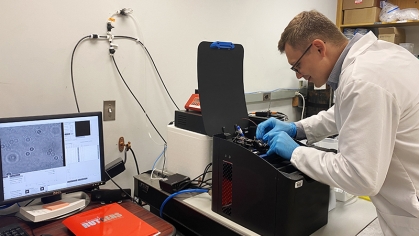
Bhattacharya's expertise in algal biology, genomics, and evolutionary biology will guide the multi-omics analysis of microbiome and algal datasets, while Chundawat will focus on the integration of the discovery-to-structure pipeline, enzyme characterization workflows at EMSL and Rutgers BioFoundry, and downstream bioprocessing applications.
Their team will include Rutgers graduate students and postdoctoral researchers, who will receive exceptional training and first-hand experience in working at the intersection of multi-omics, enzyme discovery, and sustainable bioenergy.
Ultimately, the core technology and enzymatic strategies developed in this project, Chundawat says, "could inform management and valorization approaches for other nuisance macroalgae and biomass challenges facing coastal regions, including local waterways closer to the U.S. east coast."