CBE Assistant Teaching Professor Receives Prestigious 2025 AIChE Research Award
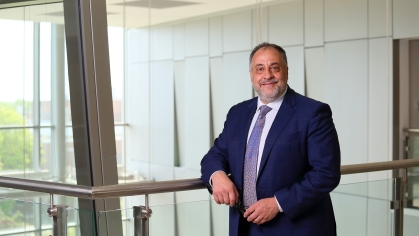
Nick Corrente, an assistant teaching professor in the Department of Chemical and Biochemical Engineering (CBE), is the recipient of the coveted 2025 American Institute of Chemical Engineers (AIChE) Separations Division Graduate Student Research Award for Adsorption and Ion Exchange.
The award from AIChE, a leading international group for chemical engineers, recognizes outstanding graduate students. Corrente's award is based on a single paper that is part of his doctoral dissertation, which he defended in December 2024, that makes a significant contribution to the field of separations.

"Area 2E in the Separations Division has been my home since I got involved in AIChE," says Corrente. "It's a great honor to be recognized by my peers, and it is a validation of our group's work during my PhD. Personally, it is a great cap on my career as a PhD student."
According to Corrente, nanoporous carbons are used in a number of industrial applications, which means that having a toolbox of characterization techniques to help understand adsorption properties goes a long way to optimizing their use.
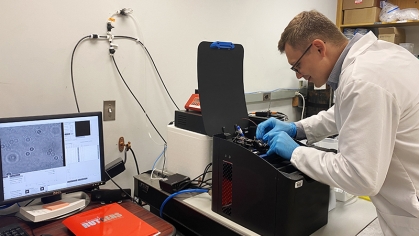
Written with the help of undergraduate CBE students Lizy Hinks, Aastha Kasera, and Raleigh Gough who worked under Corrente's mentorship, the award-winning paper bridges molecular modeling and real-world materials.
"Traditionally, we have used simplified theoretical models to predict the adsorption properties of carbons," he explains. "We showed that theoretical 3D carbon models that have been produced for decades could be used to accurately predict adsorption behavior with standard parameters."
Corrente describes the paper as a proof-of-concept that guided much of Corrente's dissertation. "It focused on a multi-scale approach to modeling nanoporous carbons. Bridging the gap between simplified and realistic carbon models comprised the second half of my doctoral work," he reports.
Since then, his research focus has shifted somewhat. "I'm working less on carbons now than I was, but the tools we developed are extensible to many classes of flexible nanoporous materials," he says. "So, while the systems are different, the tools are the same."