SoE Students Win International 2026 OpenAir Carbon Removal Challenge
A collaborative team of School of Engineering Department of Materials Science and Engineering (MSE) and Department of Civil and Environmental Engineering (CEE) students was one of four winners in the 2026 OpenAir Carbon Removal Challenge.
The team competed against 37 teams from 8 countries, presented their work at the Carbon Unbound East Coast 2026 conference in Manhattan where they were able to network with industry leaders, investors, and researchers.
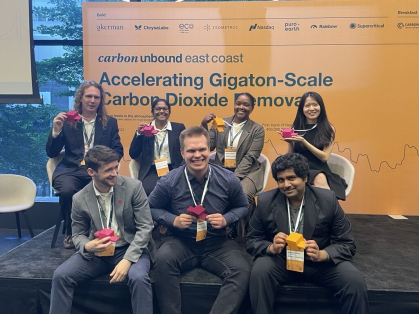
The annual competition invites student teams from around the world to devise innovative, scalable, and cost-efficient approaches for removing carbon dioxide from the atmosphere. SoE’s winning team, composed of MSE PhD students Jackson Kaszas, Noémie Denis, Karna Krishna, Oleksiy Golub, and Richie Campbell, and MSE postdoctoral researcher Ranuri S. Dissanayaka Mudiyanselage, as well as CEE PhD student Yu Zhou, was advised by MSE Professor Richard Riman and CEE Assistant Professor Yalin Li.
The team proposed a new method for capturing and permanently sequestering atmospheric carbon dioxide by transforming concrete construction waste from demolished buildings into an effective tool for mitigating the deleterious effects of climate change.
MSE doctoral student Jackson Kaszas noted the valuable exposure the contest gave “to our promising removal technology and the hardworking team that developed it. I hope this award brings attention to the incredible sustainable technologies that Professor Riman and other researchers at Rutgers have developed.”
Of course, the team encountered various challenges on the path to success. The greatest of which, according to Kaszas, was the uncertainty in proving that their solution could translate from the lab to a larger scale. “Our calculations were enough to convince the judges, but we won’t really know whether our method works on a larger scale until we go ahead and try it.”
“This achievement reflects the culture we strive cultivate in the MSE department that empowers our students to pursue excellence through innovative, interdisciplinary collaboration,” says Ashutosh Goel, professor and chair of the Department of Materials Science and Engineering. “It’s a testament to the talent of our students, the dedication of our faculty mentors, and the collaborative spirit that defines Rutgers Engineering.”
“By bringing together expertise across engineering, this team has demonstrated how fundamental research can be transformed into practical solutions for one of society’s greatest challenges.”
CEE Assistant Professor Yalin Li agrees. “It’s a great example of how interdepartmental collaboration can spark the most creative engineering ideas and tackle our biggest challenges.”
She adds, “I’m incredibly proud of the team for this recognition. It shows how civil and environmental engineers can impact society and how systems-level thinking can turn a waste stream into a climate solution.”
For Kaszas, the competition itself was about more than winning. “I learned a lot about collaboration, teamwork, and the process of good science,” he insists.