
Australian Kyra Yap earned her SoE chemical engineering degree in 2020. She furthered her education by earning her master's and doctoral degrees at Stanford University. Currently a postdoctoral research fellow at the University of California, Berkeley, she will be joining MIT's chemical engineering faculty in 2027 as an assistant professor, where she will lead her own lab.
Her reputation for sterling research has earned her a place on the prestigious Forbes 30 Under 30 Science List. For the past 15 years, Forbes has been identifying next-generation leaders who, according to Forbes, possess the imagination, intelligence, and determination to shape the future.
Yap was among the 600 young leaders in 20 industries culled from more than 10,000 candidates to achieve Forbes' "benchmark of success" as a 30 Under 30 science leader.
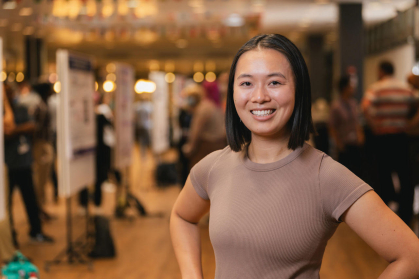
"I'm grateful to be honored on the Forbes 30 Under 30 Science list, and I'm really thankful to all the people who supported me to make it to this point, particularly my family members back in Australia," she says. "This award really belongs to all of them because they sacrificed a lot to help me get to where I am today."
Turning Waste Byproducts into Valuable Resources
Up to 40% of all industrial energy use and emissions stem from the chemicals industry. Yap intends to change this by focusing her research on ways to make more efficient and sustainable chemical products by turning waste byproducts back into valuable resources.
"I think there's a lot of value in waste products in a world where things are finite. Being able to circularize economies will make us more independent," Yap explains. "I also believe that waste products can be a lot easier to source than some of the existing supply chains we rely on."
Her PhD research at Stanford, she reports, "focused on solar-driven electrochemical technologies, specifically on photelectrical chemical and photovoltaic electrochemical architectures." Working to understand how these technologies evolve under normal conditions such as daily changes in lighting and temperature, she focused on "converting carbon dioxide into more valuable chemicals, and hydrogen evolution, where we split water to form hydrogen and oxygen."
Yap's current post-doc research, she adds, "is to characterize the ion transport properties of solid-state electrolytes, so that we can design safer batteries. My goal is to combine this with my PhD work into my eventual faculty research program.
"At MIT, my lab will be focused on designing electrochemical reactors that leverage thermodynamics, kinetics, and transport to sustainability circularize resource economies."
As one of Forbes' 30 Under 30, she notes that she "became a faculty member to train the next generation of scientific leaders. I hope that my biggest contributions will come through the people that I mentor during my time at MIT."


