
"It was a privilege to take classes with amazing professors and have access to so many resources. I'd not think twice if asked to do my PhD again at Rutgers Engineering. It was a very happy experience." -Vishakha Ramani
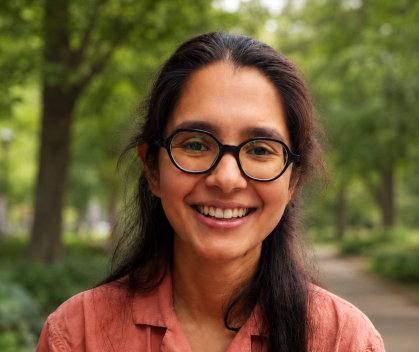
After receiving her undergraduate engineering degree in India, Vishakha Ramani enrolled at Rutgers School of Engineering, where she earned both her master's and doctoral degrees in electrical and computer engineering (ECE). Since 2024, she has been a research staff member at the IBM Thomas J. Watson Research Center, where she had held summer internships in 2022 and 2023 while completing her PhD.
Why Rutgers?
After completing my undergraduate studies in India, I wanted to develop solid foundations in wireless communications and networking. Rutgers' Wireless Information Network Laboratory, or WINLAB, is a leading center for that. I didn't look elsewhere, as I wanted to work with professors at WINLAB.
What drew you to the field of wireless communication?
We see it everywhere! When I was an undergraduate, there was talk about how 4G was coming and would transform the internet and how people communicate. I was fundamentally interested in how these systems work.
What changes have you seen in the field?
Since then—including while I was doing my PhD—people were underestimating the explosion of AI, which has significantly changed how people do their research and use software systems.
What did you explore in your dissertation?
Time-critical applications, ranging from autonomous vehicles to virtual reality and remote surgery, require fresh and timely information updates. But sending information either too often or too infrequently can be detrimental. My dissertation focused on the performance modeling and analysis of producer-consumer systems.
Time-critical applications for everything from autonomous vehicles to remote surgery need quickly delivered, up-to-date information. I studied what happens to updates after they're generated. A key insight was that acting immediately on every update is not always best. Sometimes waiting can avoid processing information that will soon be replaced to produce a fresher result.
How does your work at the Thomas J. Watson Research Center connect to your doctoral research?
My work at IBM has two threads. First, I build mathematical models of the computing systems that run large language models. When many people use a model at once, their requests share the same expensive accelerator, so a decision made for one request changes the delay experienced by requests already in service. I use these models to explain how a system behaves as demand changes, estimate actual user delays, and guide decisions about capacity and where each request should run. I test the models in simulation and on live serving systems.
The second thread is AI-native systems research, where an AI coding agent can inspect a system, propose an explanation, run an experiment, and use the result to decide what to test next. What interests me is whether that process produces reliable knowledge rather than just plausible-looking results.
While this work's subject matter differs from my doctoral research, the underlying methodology of reducing a complex system down to its core governing mechanisms is the same.
At Rutgers, I learned to state assumptions so clearly that flaws become immediately obvious, and to audit a model whenever its predictions diverged from real-world behavior. This final step is particularly vital today, as AI agents can easily generate results that look plausible on the surface without establishing why they worked or where they fail. In an AI-driven research landscape, knowing exactly what a claim rests on matters more than ever.
How did your Rutgers Engineering experience prepare you for your current role?
My PhD training shaped how I approach new problems. WINLAB particularly brought mathematical modeling and experimentation into play to make problems make sense in the real world and showed me it was possible to move between theory and implementation.
It was also a privilege to take classes with amazing professors and have access to so many resources. I'd not think twice if asked to do my PhD again at Rutgers Engineering. It was a very happy experience.
What do you most enjoy about your job?
I like the daily research problems and challenges. I think I like suffering. My Rutgers advisor, Roy Yates, a distinguished professor in ECE and the associate director of WINLAB, taught me that a little bit of suffering is good for your soul. When you suffer riding a bike uphill, but then see the descent, all the work of climbing the hill makes the journey downhill more enjoyable. I try to use that teaching in the work I do.
Will AI render engineering technical skills obsolete?
I don't think so, but it does change which skills matter. AI has the potential to help with everything from medical diagnoses to building spaceships, and it is very good at producing something that's built to look like the answer you asked for. But that's not the same as being right. So, somebody has to be able to tell the difference.
That is what I would not want to lose—being able to judge a result. That can come down to having some sense of what the answer should look like, so you notice when it's wrong. That sense comes from the fundamentals and from having done the work by hand at some point. I do not think that goes away.
What advice do you have for future engineering students?
Hands-on work can't be replaced. Try to be creative—the real value is creativity. And don't be afraid to do the hard stuff.
If you could go on vacation tomorrow, where would you go?
I've never been to Hawaii, and I'd really like to go there.


